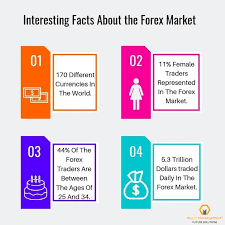
Foreign Exchange, better known as FOREX, is the largest and most liquid financial market in the world. Yet despite its massive scale, many people only scratch the surface of what makes this market truly fascinating. Beyond charts and currency pairs, FOREX is a global ecosystem shaped by economics, psychology, politics, and technology.
Here are some interesting and eye-opening facts about FOREX that may change how you see the market.
1. FOREX Is Bigger Than All Stock Markets Combined
The daily trading volume in the FOREX market exceeds trillions of dollars, making it larger than:
- The New York Stock Exchange
- NASDAQ
- All major global stock exchanges combined
This immense liquidity is why FOREX traders can enter and exit positions almost instantly, even during volatile market conditions.
2. FOREX Trades 24 Hours a Day, Five Days a Week
Unlike stock markets with fixed trading hours, FOREX operates continuously from:
- Monday morning in Asia
- To Friday night in New York
This happens because trading moves across time zones—Asia, Europe, and North America—allowing global participation around the clock.
3. No Central Exchange Controls FOREX
FOREX is a decentralized market, meaning:
- There is no single exchange or central location
- Trades occur electronically through a global network of banks, brokers, and institutions
This structure reduces single-point failures and increases market resilience.
4. Central Banks Are the Most Powerful Players
While retail traders get most of the attention online, central banks are the real market movers. Institutions such as:
- The Federal Reserve (Fed)
- European Central Bank (ECB)
- Bank of Japan (BoJ)
Can shift entire currency trends with interest rate decisions, policy statements, or market interventions.
5. Most FOREX Trading Is Done by Institutions, Not Individuals
Contrary to popular belief:
- Retail traders make up only a small fraction of total FOREX volume
- Banks, hedge funds, corporations, and governments dominate the market
This is why understanding institutional behavior is more important than chasing short-term signals.
6. Currencies Are Always Traded in Pairs
In FOREX, you never buy a currency alone. You always trade one currency against another, such as:
- EUR/USD
- GBP/JPY
- USD/JPY
When you buy one currency, you are simultaneously selling another.
7. FOREX Reflects Global Economic Health
Currency prices react instantly to:
- Interest rates
- Inflation data
- Employment reports
- Geopolitical events
In many cases, FOREX markets react faster than stock markets, making them a real-time indicator of global economic sentiment.
8. Leverage Is a Double-Edged Sword
FOREX allows traders to control large positions with relatively small capital through leverage. While this can:
- Amplify gains
It can also:
- Magnify losses just as quickly
Professional traders focus more on risk management than on leverage itself.
9. The Most Traded Currency Is the US Dollar
The US dollar appears in nearly 90% of all FOREX transactions, making it the world’s primary reserve and settlement currency.
This dominance reflects:
- The size of the US economy
- Global trade relationships
- Trust in US financial institutions
10. FOREX Is Heavily Influenced by Psychology
Market sentiment, fear, and confidence often move prices just as much as economic data. Successful traders understand that:
- Emotional discipline is critical
- Markets often move on expectations, not facts
In FOREX, perception can be as powerful as reality.
11. FOREX Is One of the Oldest Markets in the World
Currency exchange dates back thousands of years, from:
- Ancient merchants trading coins
- To the gold standard
- To today’s digital currency markets
FOREX has evolved, but the core idea—exchange of value across borders—remains unchanged.
12. Technology Has Transformed FOREX Trading
High-speed algorithms, AI-driven strategies, and electronic trading platforms now dominate the market. Many large institutions execute trades in:
- Microseconds
- Automated systems
Human traders now compete in a technology-driven environment.
13. FOREX Trading Is Not About Predicting—It’s About Managing Risk
One of the biggest misconceptions is that successful traders predict the market. In reality, professionals focus on:
- Probability
- Risk-to-reward ratios
- Capital preservation
Consistency matters more than being right.
14. FOREX Never Sleeps—But Traders Should
Just because the market is always open doesn’t mean you should trade all the time. Professional traders:
- Wait for high-probability setups
- Avoid overtrading
- Respect rest and discipline
Fatigue is one of the most underestimated risks in trading.
15. FOREX Is a Mirror of Global Power Shifts
Changes in currency strength often reflect:
- Shifts in economic leadership
- Political stability
- Global capital flows
FOREX doesn’t just follow the world—it reveals it.
Conclusion
FOREX is far more than charts and price movements. It is a global system shaped by economics, psychology, technology, and human behavior. Understanding these deeper dynamics turns trading from guessing into strategy.
Whether you trade actively or simply observe markets, one thing is certain:
FOREX is where the world’s money tells its story—every single day.
Word Count:
345
Summary:
Most experienced traders consider that the best and most profitable of the capital markets is the FOREX market.
Keywords:
forex,forex trader,forex trading,forex trade,forex broker,moving averages,forex education,forex articles,
Article Body:
Most experienced traders consider that the best and most profitable of the capital markets is the FOREX market. During many years FOREX trading had been the sole domain of major banks, large financial institutions and countries central banks; for example the U.S. Federal Reserve Bank. But these days, thanks to the internet the market has been opened to everyone willing to learn the best techniques in forex trading and with the intention of making substantial profits as the before mentioned institutions that annually and consistently make pretty high profits from trading in the Foreign Exchange market.
Forex is a market that is continually oscillating and in consequence with good trading opportunities during the whole trading day; this behavior is in part due to the increase in global trade and foreign investments during the last two decades that has made the economics of all countries more dependent upon one another. This means that as a country’s currency fluctuates as a result of economic activity it affects the currency of other countries. For example; economic factors usually affect a currency by altering the interest rate structure and these will either appreciate or devalue the currency of that particular country and reflect the monetary health of its economy.
It is known that some banks allocate as much as 20-30% of their funds into the FOREX market, making 40-60% of all their profits trading currencies. In fact there are experts that consider that banks will cease their loan transactional business in a few years, and better focus on currency trading as their primary revenue source.
The forex market has five major currencies: US Dollar, Japanese Yen, British Pound, Euro and the Swiss Franc. It is due to their great popularity in world’s commerce transactions and its high activity that these five currencies account for over 70% of North American trading. Of course there are other tradable currencies; they include the Canadian, Australian and New Zealand Dollars. These minor currencies account for 4% – 7% of the total market volume. Together, all this five majors and minors currencies constitute the backbone of the FOREX market.

Tinggalkan Balasan